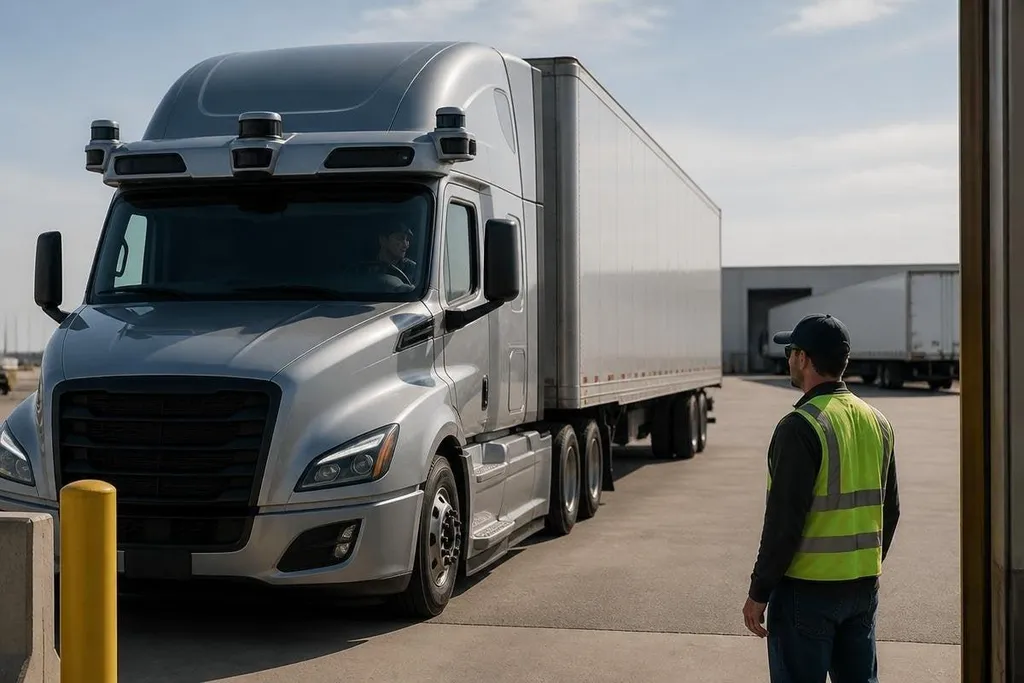
A self-driving truck may spend most of a long trip on a highway, then hand control to a person near the freight yard. That setup could change long-haul work without removing people from the whole delivery route.
- Highway driving is the easier part to automate
- Yard work and bad weather still need close checks
- The business case depends on safe handoffs and useful routes
Where the truck could operate alone
Highways give an autonomous truck a more limited set of problems. Lanes are marked, traffic moves in the same direction, intersections are fewer, and the road usually follows a known route. Cameras, radar, and LiDAR can read nearby vehicles, lane lines, road edges, and objects.
The truck’s software combines those sensor readings with maps and vehicle data. It chooses a path, controls the steering, brakes, and motor, then checks whether the road still matches its map. If the system cannot read the road with enough confidence, it needs a safe way to slow down or stop.
That last part matters more than a smooth demo. A truck carrying a heavy trailer needs more stopping distance than a car, so a late response can create a much larger problem. The system must also handle roadworks, stopped vehicles, tire debris, emergency vehicles, and people who change lanes without warning.
The route may split into two jobs
A practical operating model could use autonomous travel on a mapped highway section and a trained person for the first and last parts of the trip. The person might take control near a depot, distribution center, city street, or loading yard.
This changes the job rather than removing every transport task. One person could move a truck through a busy site, while the automated system covers the long highway section. That may reduce time spent on repetitive highway miles, but it adds rules for control transfer, parking, inspections, and remote support.
The handoff needs a clear location and enough space. A narrow roadside pull-off may not work for a large trailer, especially if the person must enter the cab, check the vehicle, and take control while traffic passes nearby.
That space requirement changes the job for freight operators. A truck that drives most highway miles still needs people and safe sites for handoffs, remote help, and inspections. Robot 24 can help you compare those details with the route and task a company says its truck can handle.
What changes for freight operators
A carrier would need more than a truck with sensors. It would need mapped routes, service staff, remote help, insurance rules, and a plan for cargo when the truck stops.
Depot design could change too, because the site may need marked handoff areas and space for trucks waiting for trained people.
The savings also depend on how the truck is used. A vehicle that travels alone for most of a route still loses time if it waits for a person at both ends. A route with repeatable highway miles may fit the model better than one with frequent city stops, narrow roads, or changing delivery points.
Fuel use, tire wear, sensor cleaning, and repair time still count. Cameras can become dirty. Radar and LiDAR can lose useful information in heavy rain, snow, fog, or spray from other vehicles. A truck that handles clear weather well may need a different operating plan when conditions change.
What remains unproven
The hard question is not whether software can steer a truck on a quiet highway. It is how the whole service behaves across weather, road repairs, sensor faults, delayed remote help, police directions, and a vehicle that needs to pull over safely.
Public road rules must also define who is responsible when the system operates. That includes the vehicle maker, the carrier, the remote operator, and any person who takes control after a warning. A business cannot plan a fleet around a system whose operating limits are unclear.
The work impact needs care too. Some transport jobs may shift toward local routes, yard moves, vehicle checks, and support work. Training will matter because taking control after a long period of automated operation may demand different skills from ordinary highway travel.
I’d wait for evidence from repeat routes and bad-weather operations before treating autonomous trucks as ready for broad long-haul use.
A practical check before buying into the plan
Use these questions when judging an autonomous truck proposal:
- Route design: How many highway miles can the system cover without a person inside the cab?
- Handoff points: Where does a trained person take control, and can a full trailer stop there safely?
- Weather limits: Which rain, snow, fog, and road-spray conditions stop autonomous operation?
- Failure response: What does the truck do after a sensor fault, map error, flat tire, or lost connection?
- Operating proof: Has the system run repeated freight trips on the exact routes the carrier wants to use?
Those answers will decide whether the truck saves travel time or only moves the delay to another part of the route. The first useful deployments will likely be the ones with fixed highways, clear handoff sites, and operating rules that state when the person takes control.